Experiments: sweeps, runs and share links
Every simulation in the workbench is kept as a run you can overlay, subtract or share, and a parameter sweep fans out over all your cores, in the browser or on the command line.
Runs
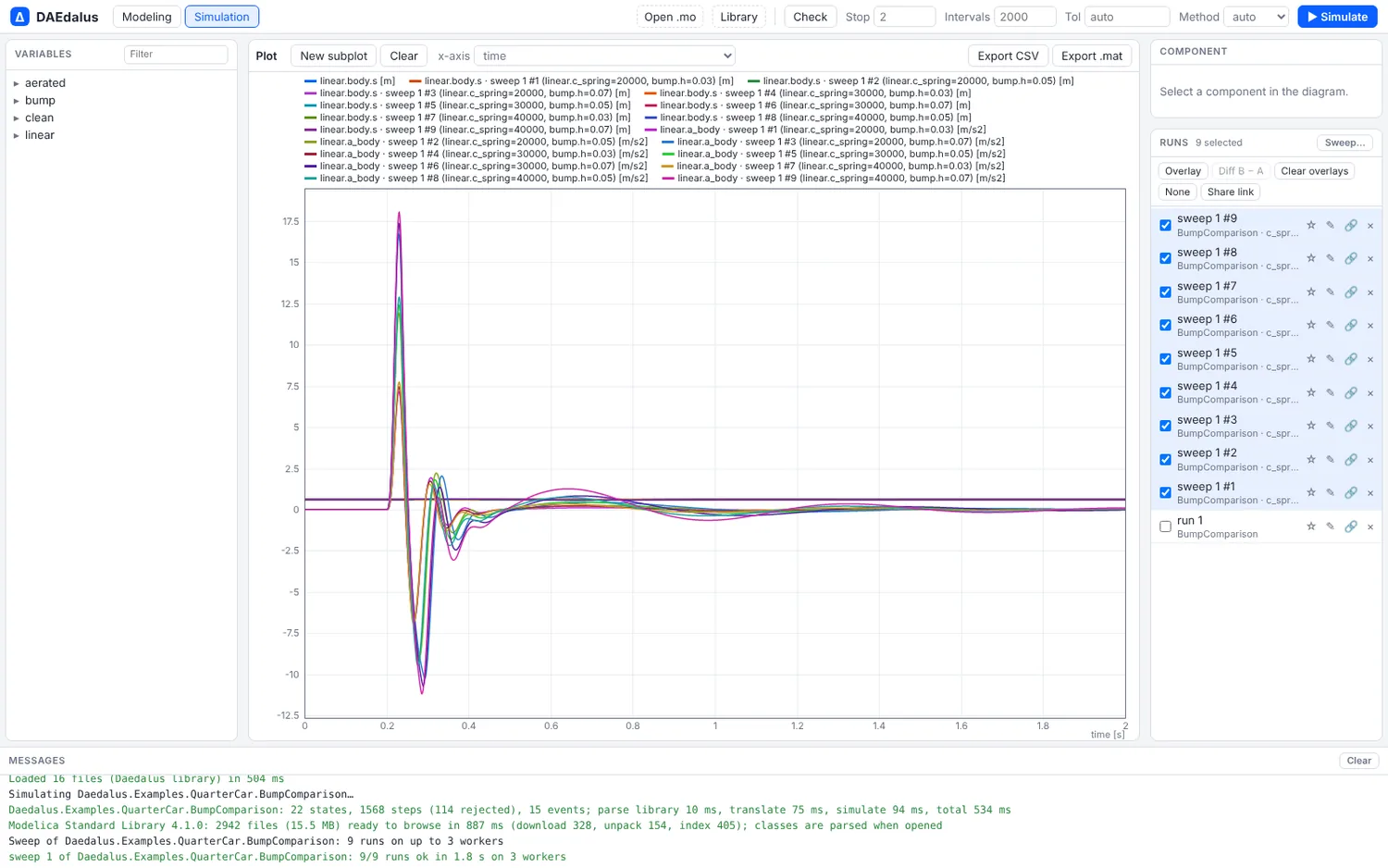
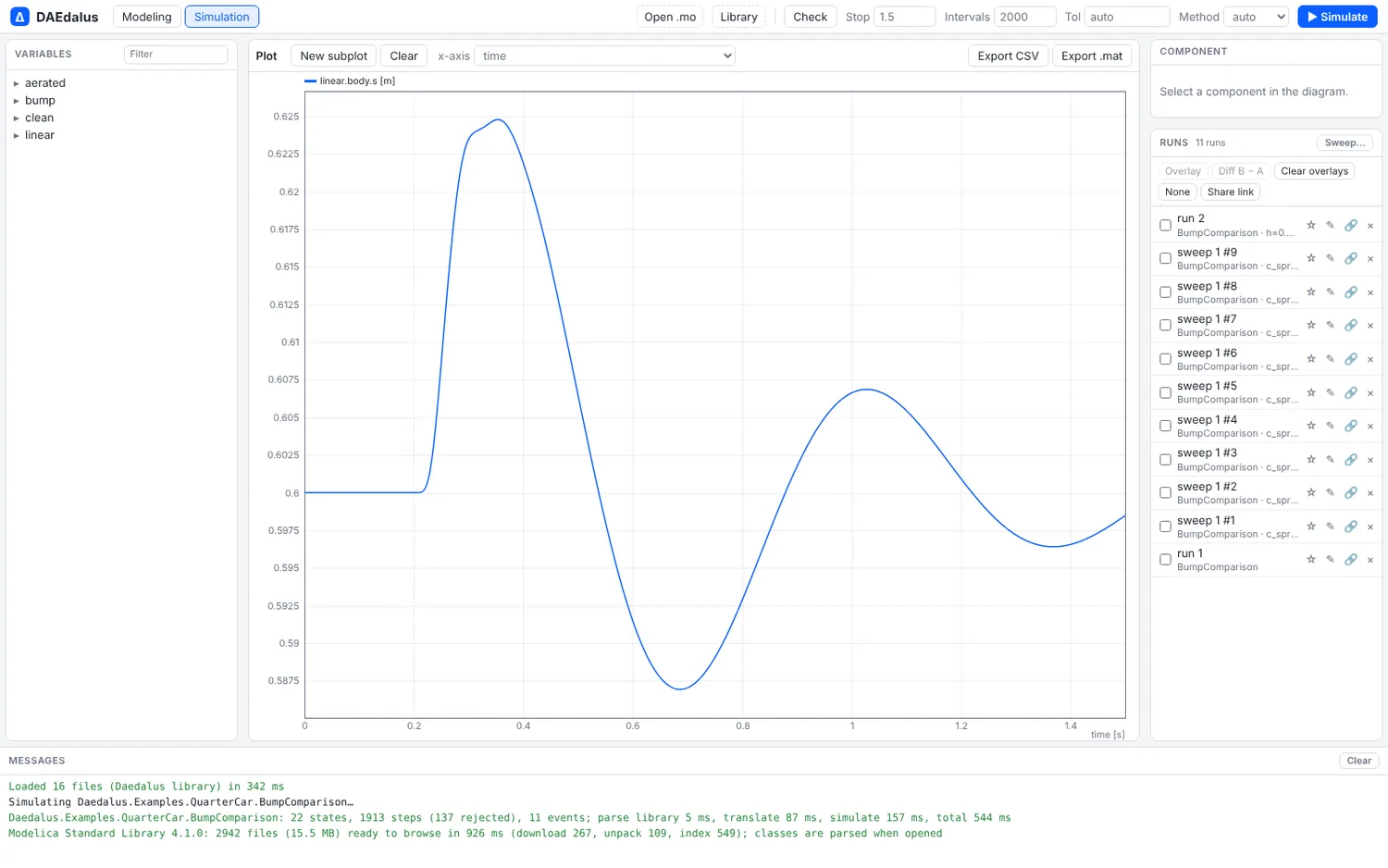
Each Simulate stores a run in the Runs pane: the model, its parameter overrides, the settings, the time and the plotted variables. Runs are kept in the browser across reloads and can be renamed, pinned and deleted.
- Overlay plots the active subplot's variables for every selected run. The legend names the run and the parameter values that differ.
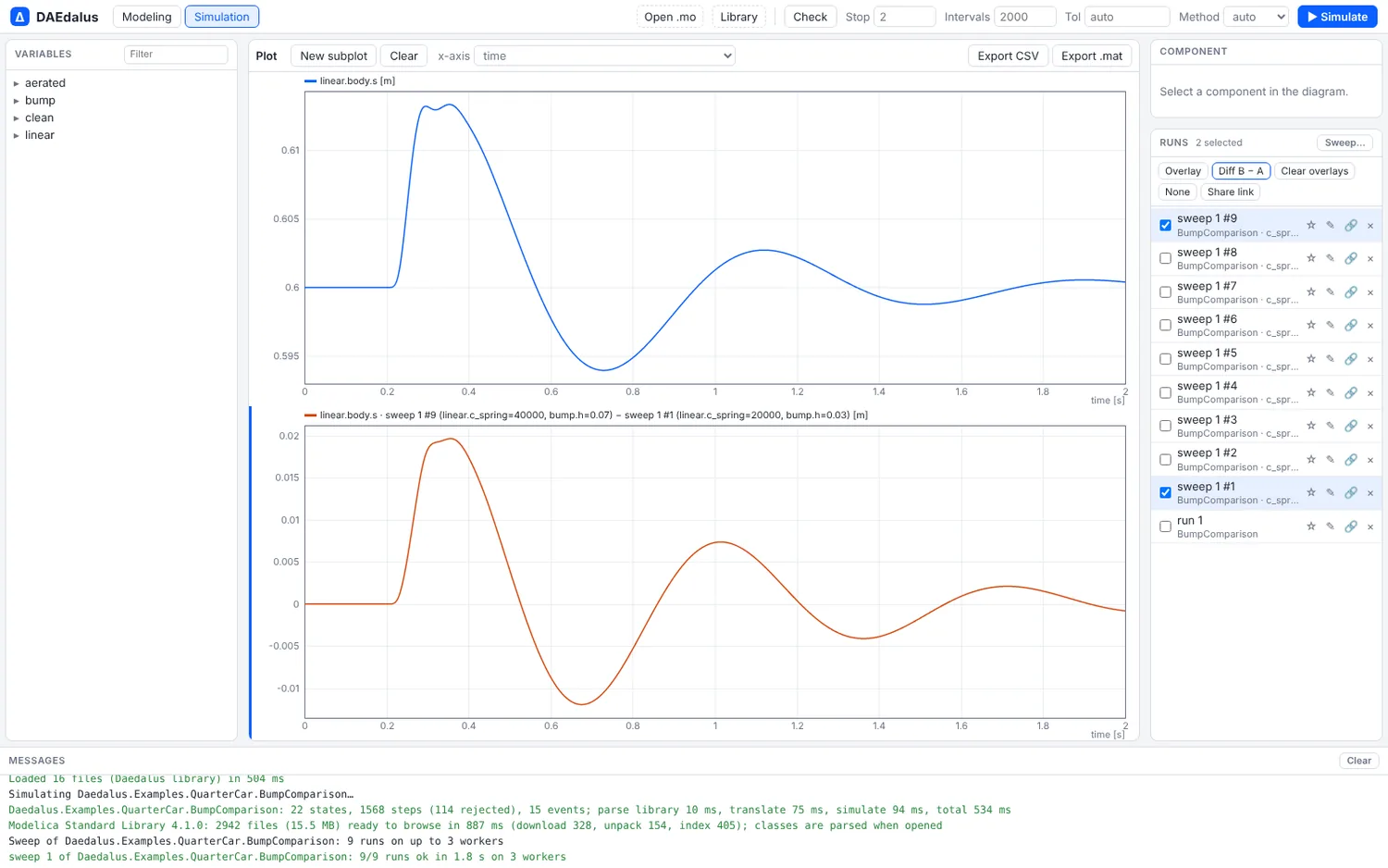
- Diff B − A plots the newer of two selected runs minus the older one, interpolated on the union of their time grids.
Sweeps in the workbench
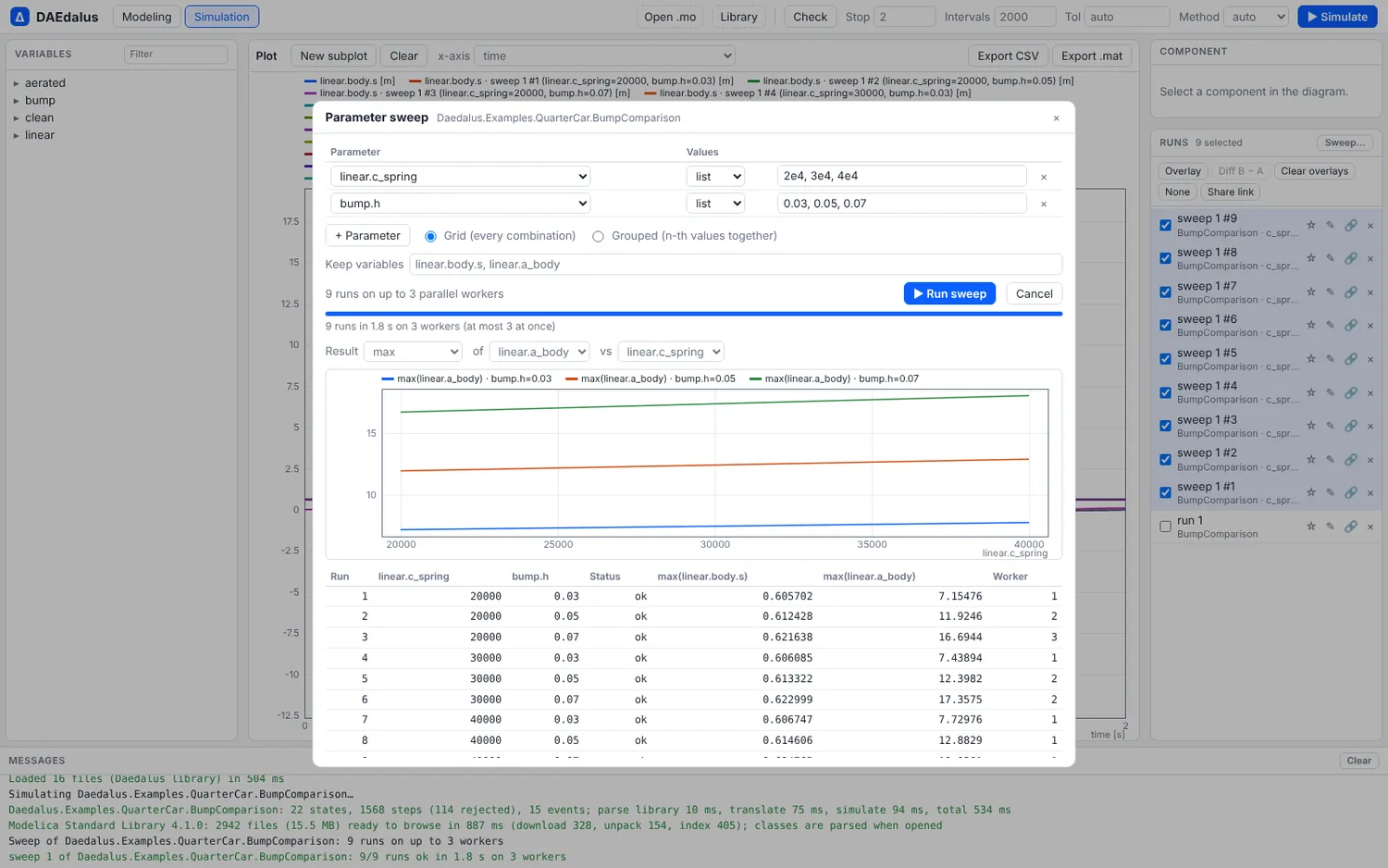
Sweep… in the Runs pane picks one or more editable parameters, each with a list, linear or logarithmic set of values, combined as a full grid or grouped (the n-th values together), and the variables to keep. The runs fan out over a pool of Web Workers, one per core up to eight, each of which translates the model once and reuses it for every run. A summary table and a plot of a scalar result (final value, maximum, minimum or mean) against a parameter follow, and the runs are overlaid in the plot.
Share links
Share link copies an address that reopens the model with its overrides and settings, simulates it and plots the chosen variables. This one opens the quarter car with a 7 cm bump and a 40 kN/m spring:
QuarterCar.BumpComparison with h = 0.07 and c = 40000
A plain #Model.Name still just opens the model.
Sweeps on the command line
daedalus sweep translates the model once and simulates every combination on its own
thread:
daedalus sweep library/Daedalus -m Daedalus.Examples.QuarterCar.BumpComparison \
    -s linear.c_spring=lin:20e3:40e3:3 -s bump.h=0.03,0.05,0.07 \
    --vars linear.body.s,linear.a_body --stats max
sweep of Daedalus.Examples.QuarterCar.BumpComparison: 9 runs (2 parameters, grid), 0 extra translations in 0 ms, 4 threads
9/9 runs ok in 268 ms
run linear.c_spring bump.h status max(linear.body.s) max(linear.a_body) error
1 20000 0.03 ok 0.605702 7.15476
2 20000 0.05 ok 0.612428 11.9246
3 20000 0.07 ok 0.621638 16.6944
4 30000 0.03 ok 0.606085 7.43894
5 30000 0.05 ok 0.613322 12.3982
6 30000 0.07 ok 0.622999 17.3575
7 40000 0.03 ok 0.606747 7.72976
8 40000 0.05 ok 0.614606 12.8829
9 40000 0.07 ok 0.624765 18.0361- Values: a list
1,2,3,lin:START:STOP:Norlog:START:STOP:N.--groupedruns the n-th values together instead of the full grid. --stats:initial,final,min,max,mean(time average) orat=Tper kept variable.-o FILE.csvwrites every run into one CSV;-o DIRwritesrun_001.csvand so on (or.matwith--format mat) plussummary.csv.- Free Real parameters change at run time on the shared compiled model. Integer, Boolean
and computed parameters, which can be structural, are applied as modifiers and
translated once per distinct value;
--retranslateforces that for all.
For a sweep inside a Dymola or OpenModelica script, see Scripts and steady states; for Python, Python API.