Modelica Standard Library
The workbench ships with the Modelica Standard Library 4.1.0: Modelica,
ModelicaServices and Complex appear in the package browser next to the bundled
Daedalus library, with nothing to install. On the command line, pass an MSL checkout as
extra sources (see Command line).
Coverage
473 of the 534 MSL 4.1.0 example models translate and simulate to the end, and 424 of them match the Modelica Association's reference results (see below). They include:
Mechanics(Rotational, Translational, MultiBody),Electrical(Analog, Digital, Machines, QuasiStatic machines, PowerConverters, Batteries),Thermal,Blocks,StateGraphand clocked synchronous models;Modelica.Media: IF97 water, R134a, ideal-gas mixtures, moist air and reference air, through compiled run-time functions with exact partial derivatives;- most
Modelica.Fluidsystems; ModelicaStandardTableslookups, replaced by native tables with linear, constant, Akima and Fritsch–Butland smoothness, hold, linear and periodic extrapolation, and time events at breakpoints.
The remaining failures, and what is being done about them, are listed in the Roadmap.
Checked against the reference results
Simulating is not enough: the results have to be right. A nightly CI job simulates every
MSL 4.1.0 example and compares its comparison signals with the Modelica Association's
reference results (MAP-LIB_ReferenceResults, generated with Dymola), and fails if a model
that passed in the committed baseline stops passing.
| Result | Models |
|---|---|
| Matches the reference results | 424 |
| Simulates, but a signal differs | 49 |
| Hits the time limit | 5 |
| Does not translate or stops | 56 |
| Total | 534 |
The scoreboard lists every example with its status, the signals that differ and the error text, with a link to open it in the workbench.
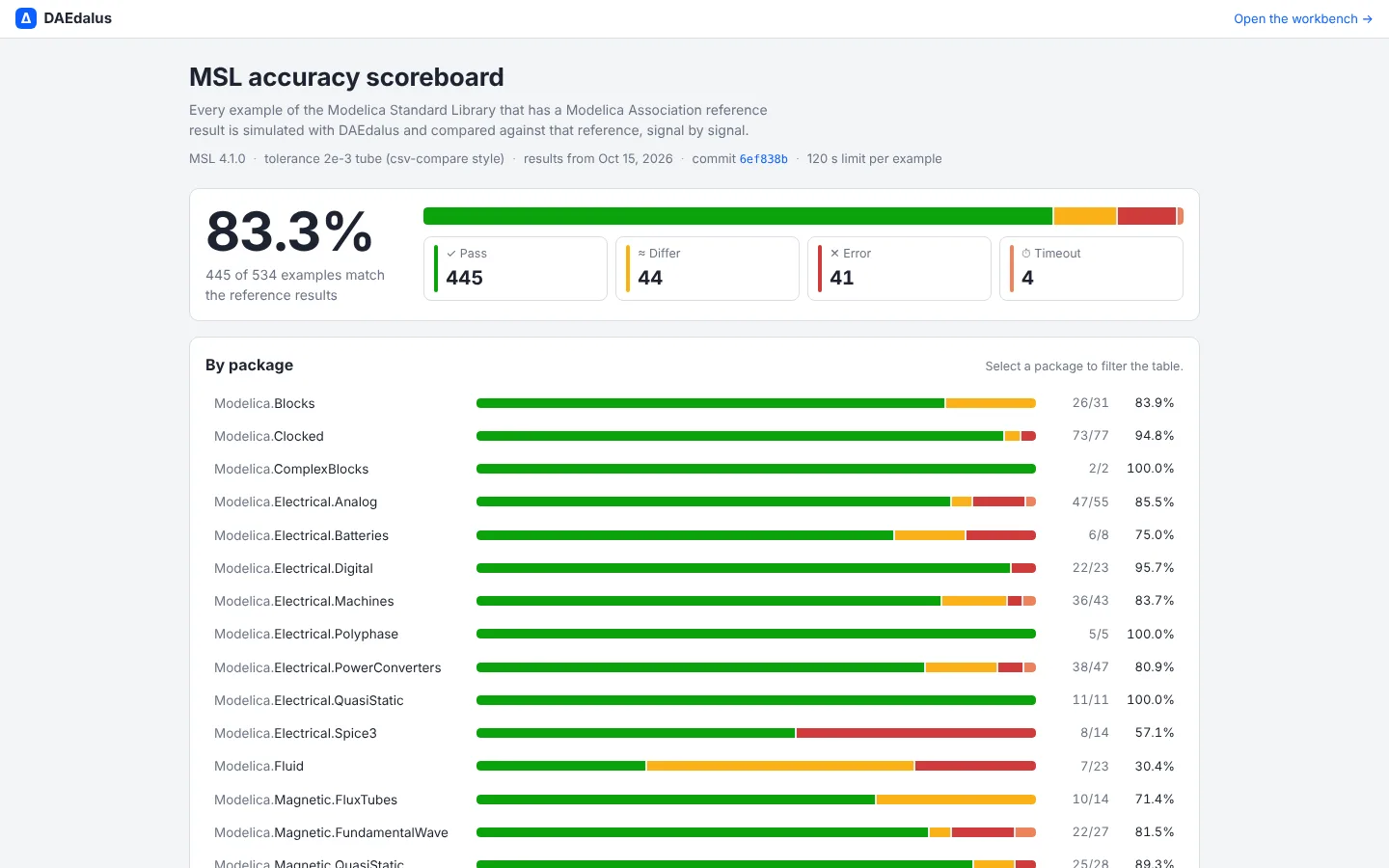
The baseline is docs/conformance/msl-4.1.0.json, made by tools/refcompare.py.
Examples to try
Each link opens the model in the workbench; press ▶ Simulate.
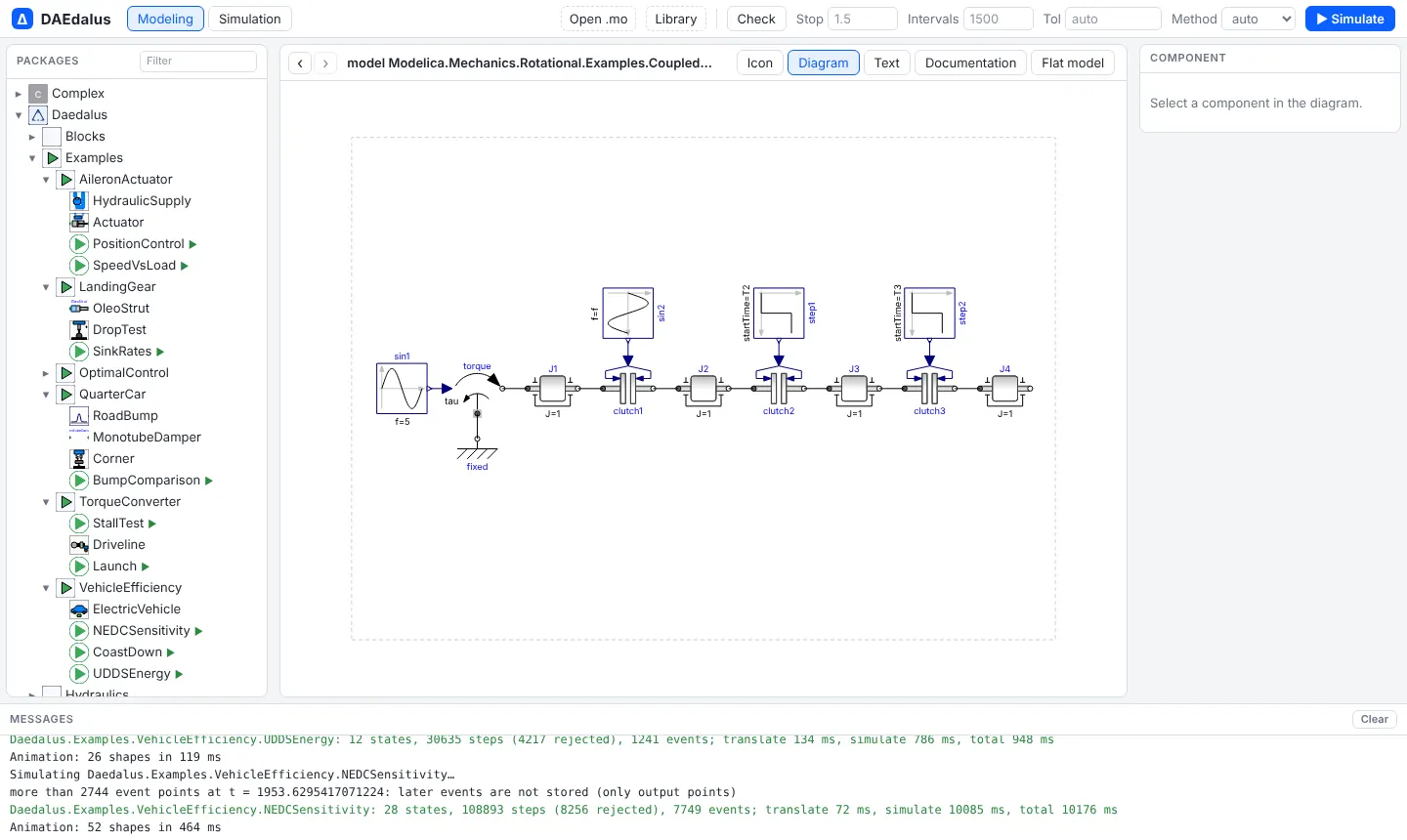
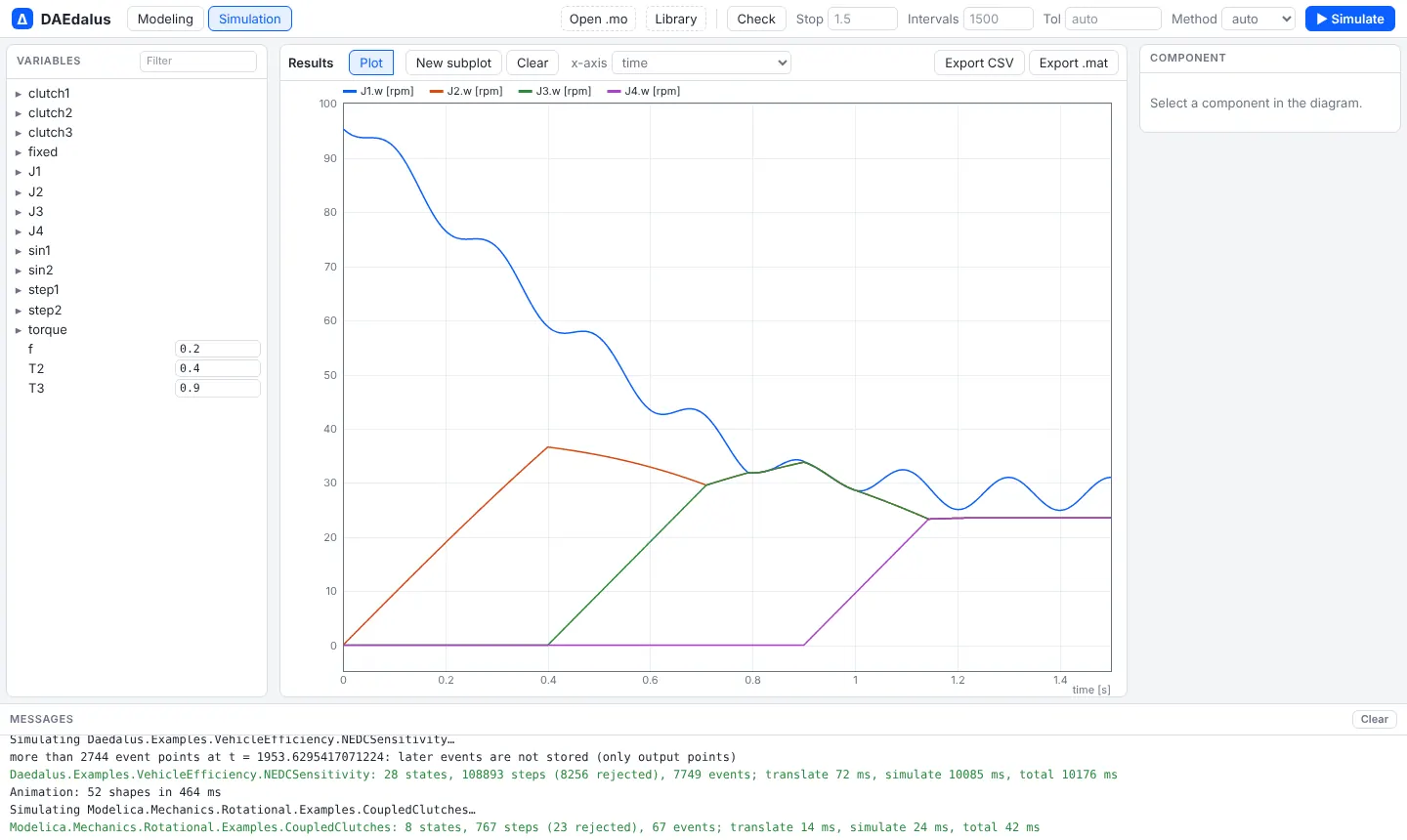
Rotational mechanics: CoupledClutches
Four inertias coupled by three clutches that open and close at set times: a classic test of friction events, stuck and sliding phases.
Open Modelica.Mechanics.Rotational.Examples.CoupledClutches
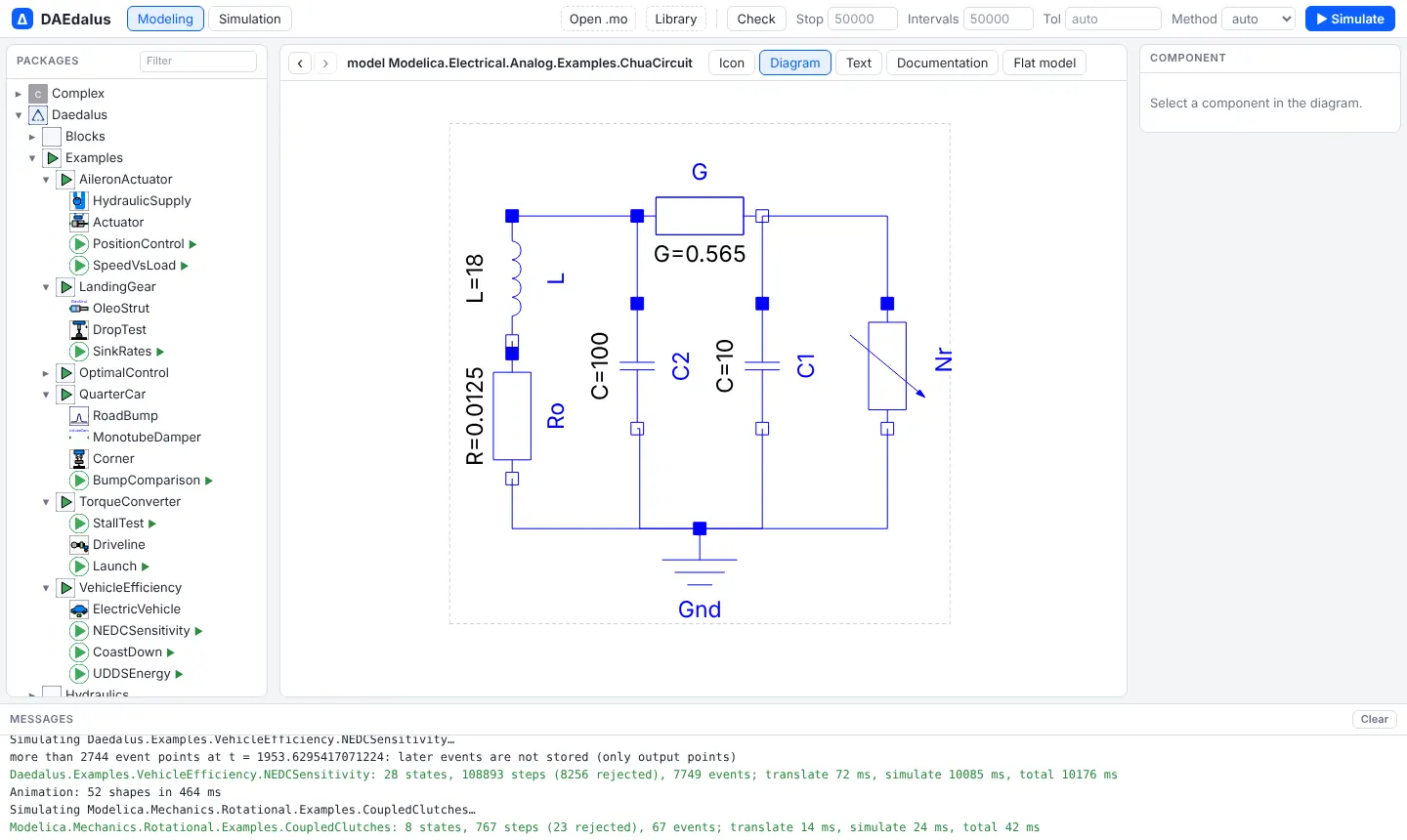
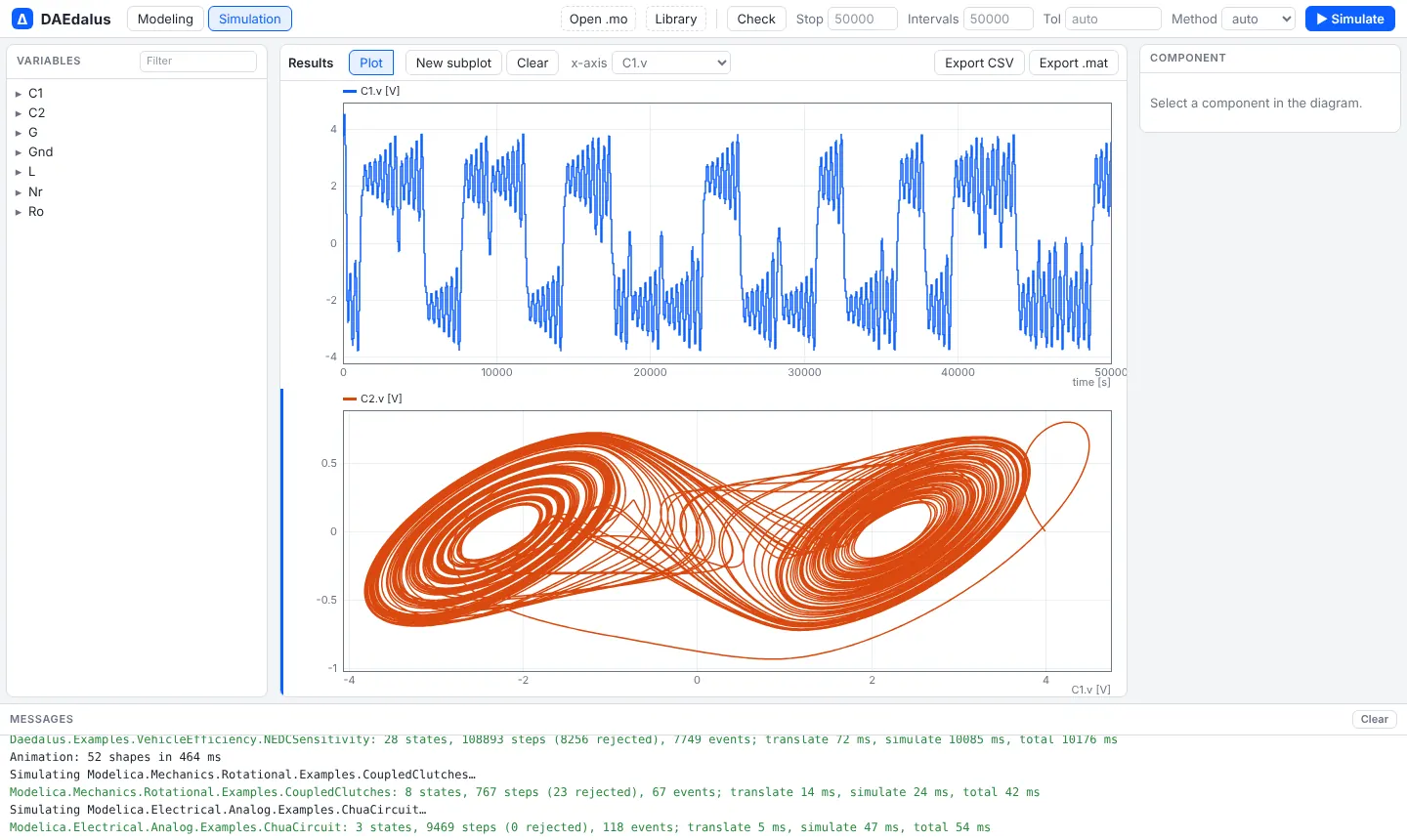
Analog electronics: ChuaCircuit
A chaotic oscillator. The second subplot plots C2.v against C1.v to show the double
scroll attractor.
Open Modelica.Electrical.Analog.Examples.ChuaCircuit
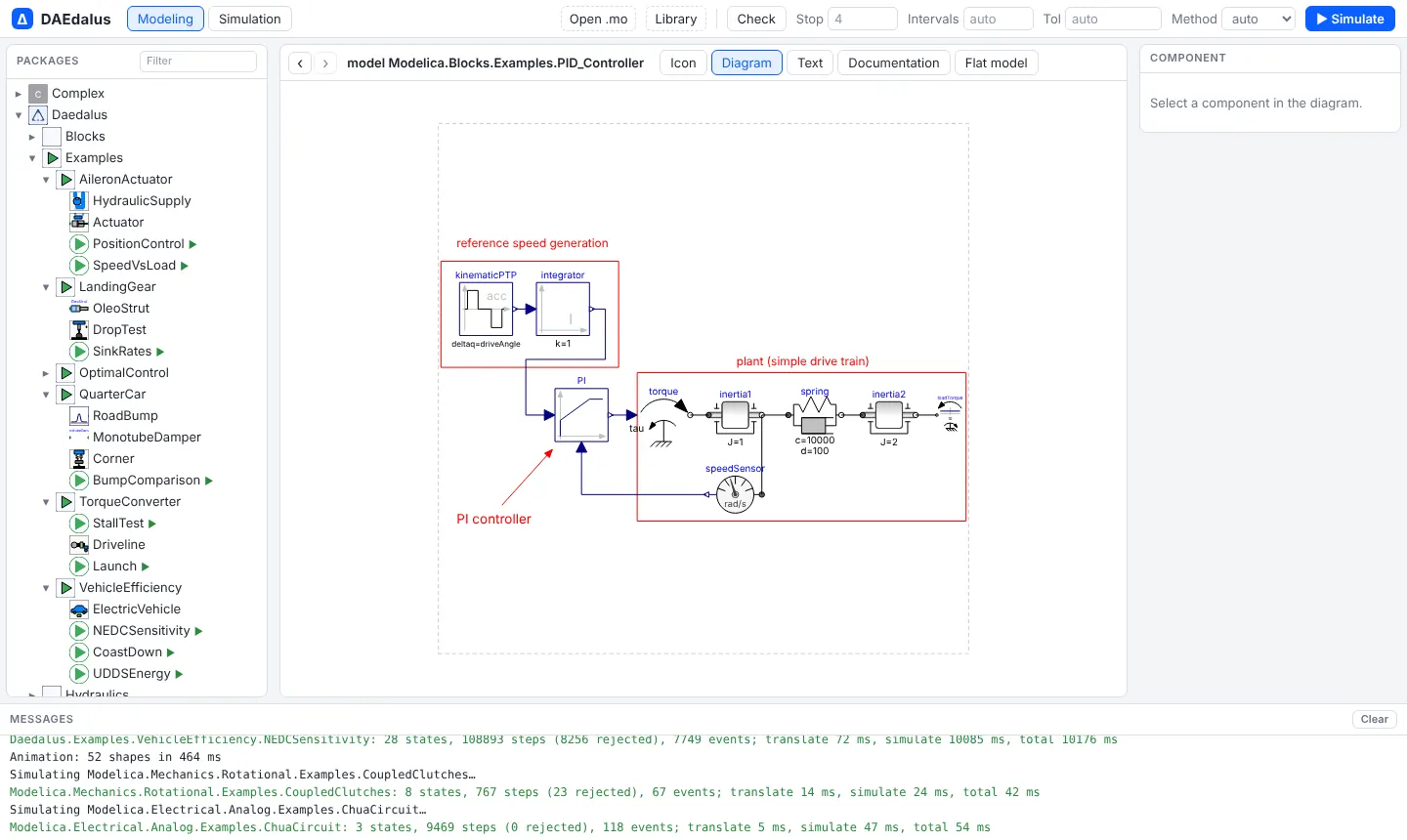
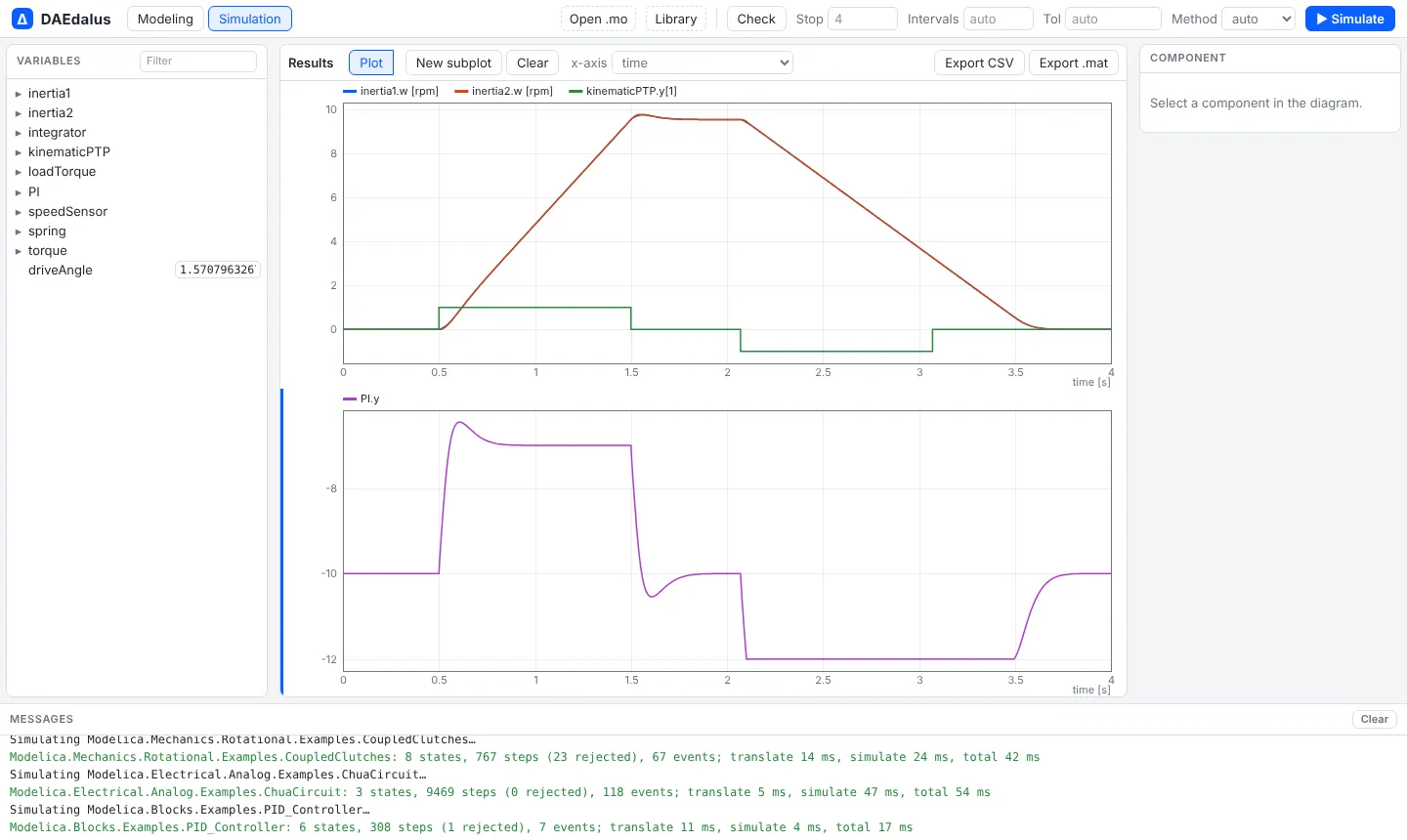
Control: PID_Controller
A drive train under a PI speed controller, following a kinematic reference profile while a load step hits it.
Open Modelica.Blocks.Examples.PID_Controller
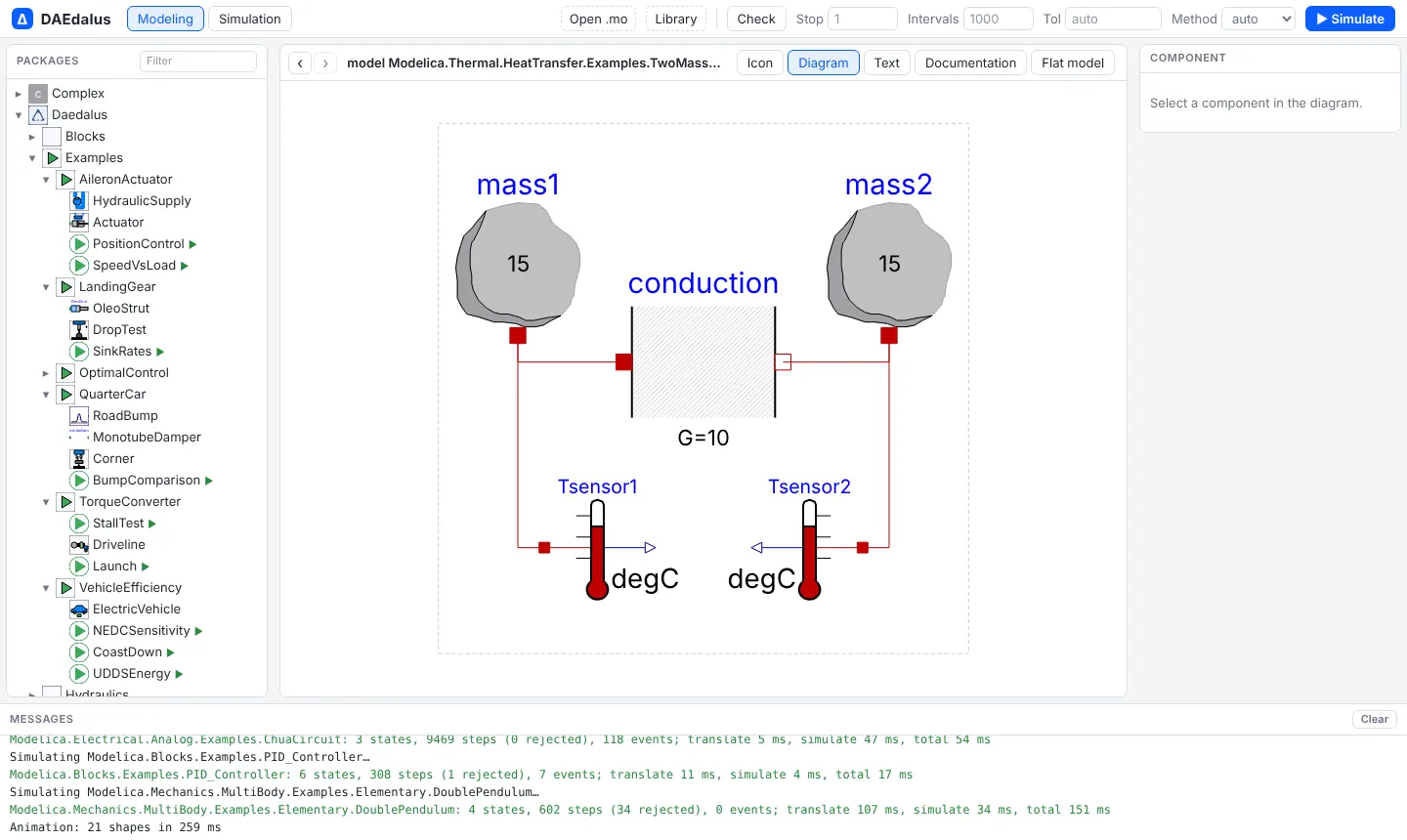
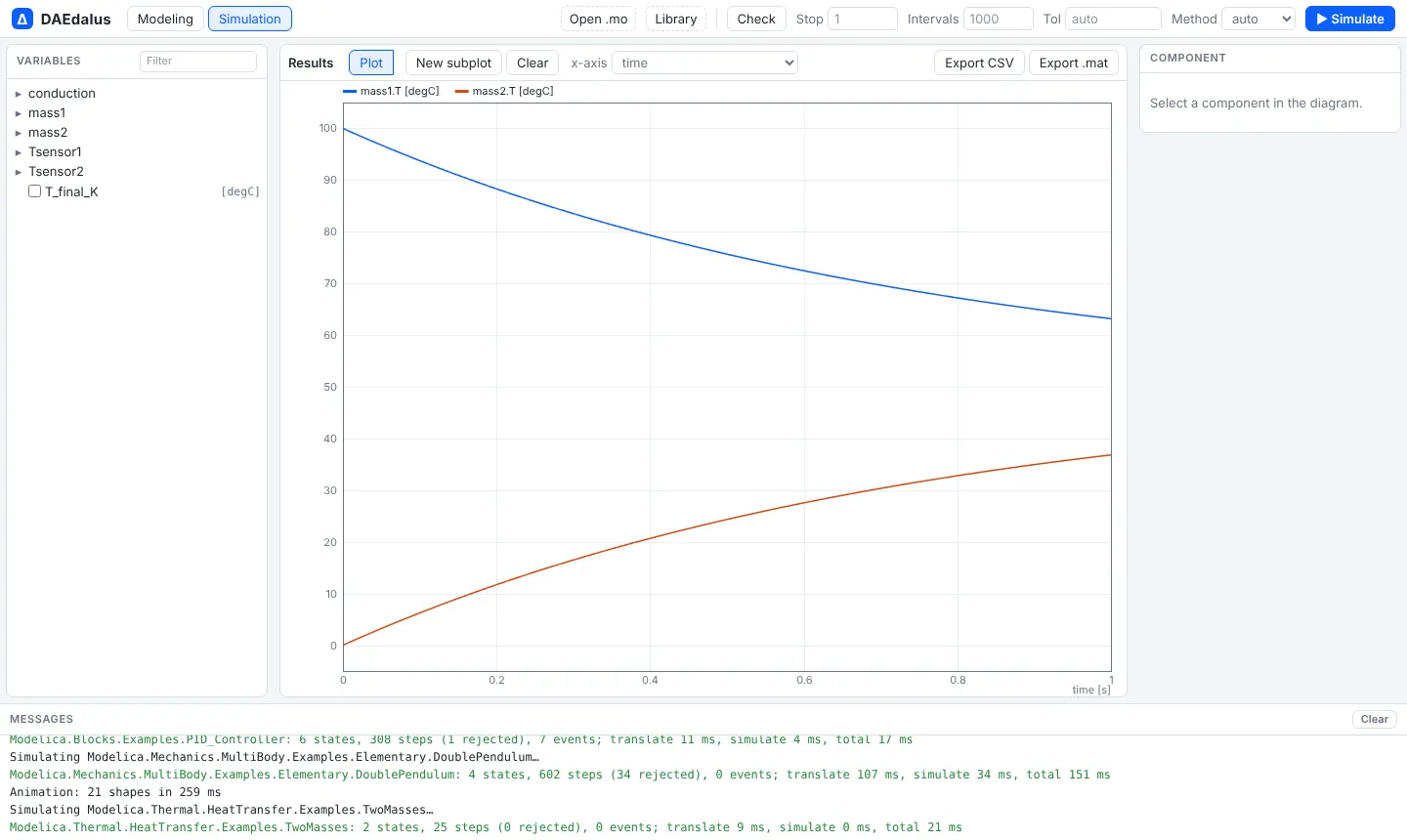
Heat transfer: TwoMasses
Two masses at different temperatures that equalize through a thermal conductor.
Open Modelica.Thermal.HeatTransfer.Examples.TwoMasses
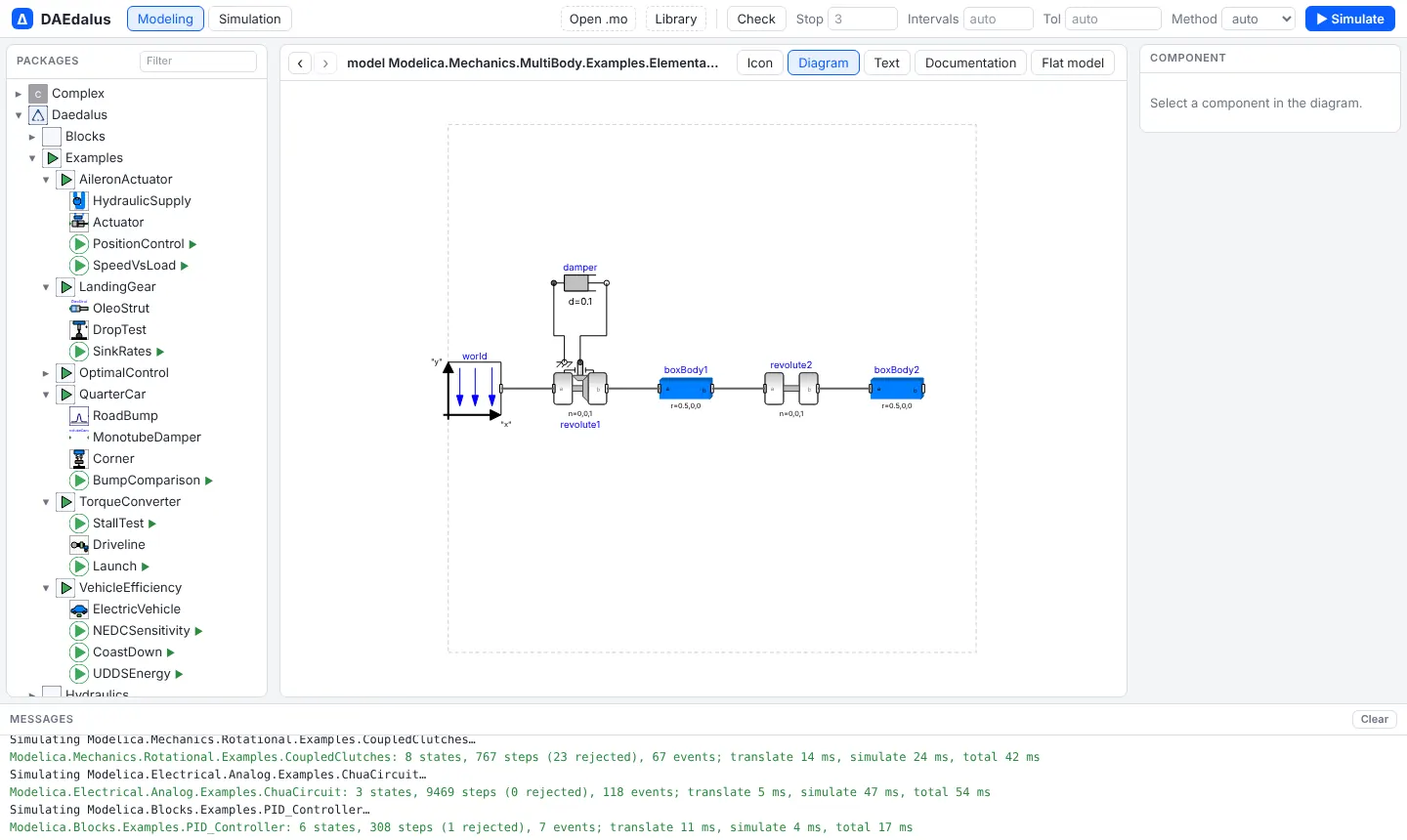
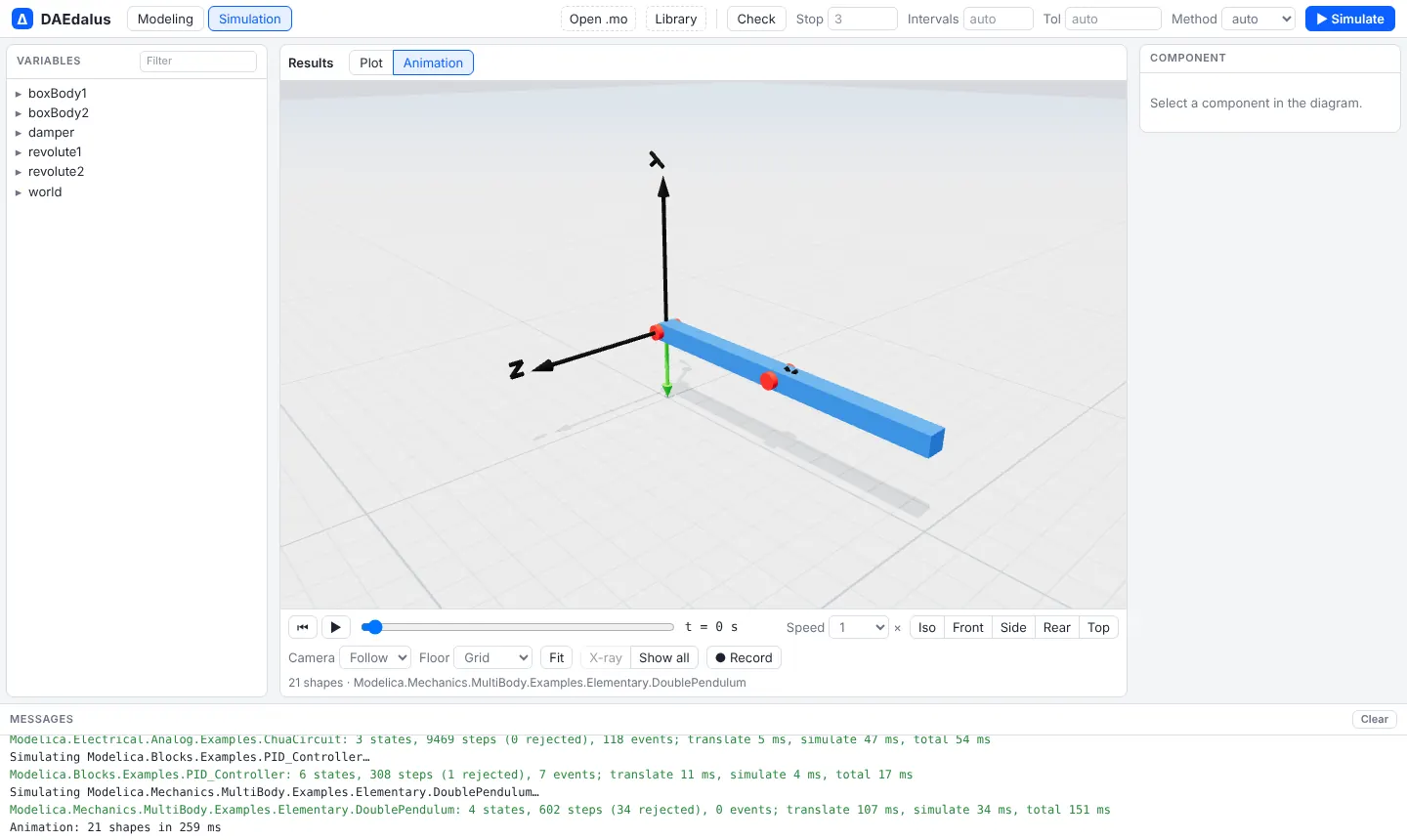
MultiBody: DoublePendulum
Two bodies on revolute joints, with the 3-D animation that every MultiBody result gets.
Open Modelica.Mechanics.MultiBody.Examples.Elementary.DoublePendulum
For full vehicle models built on MultiBody, see Multibody vehicles.
How the browser loads it
The MSL sources are not in the repository. At build time, web/scripts/fetch-msl.mjs
downloads the v4.1.0 release from GitHub and packs its .mo and package.order files into
one gzip bundle (about 2.6 MB; 14.8 MB unpacked) with a content hash in its name. The
workbench downloads it after the Daedalus library, unpacks it with
DecompressionStream, and registers every file without parsing it. A light token scan
outlines each file so the package browser lists the whole library within seconds, and a
class is parsed only when it is opened, checked or simulated, together with the classes
it needs.