Structure and state selection
Before it integrates anything, DAEdalus sorts the model's equations, reduces its index and
picks the states. The Structure view and daedalus structure show the result of each
of those steps, explain why each state was chosen, and let you choose other states
without editing the model.
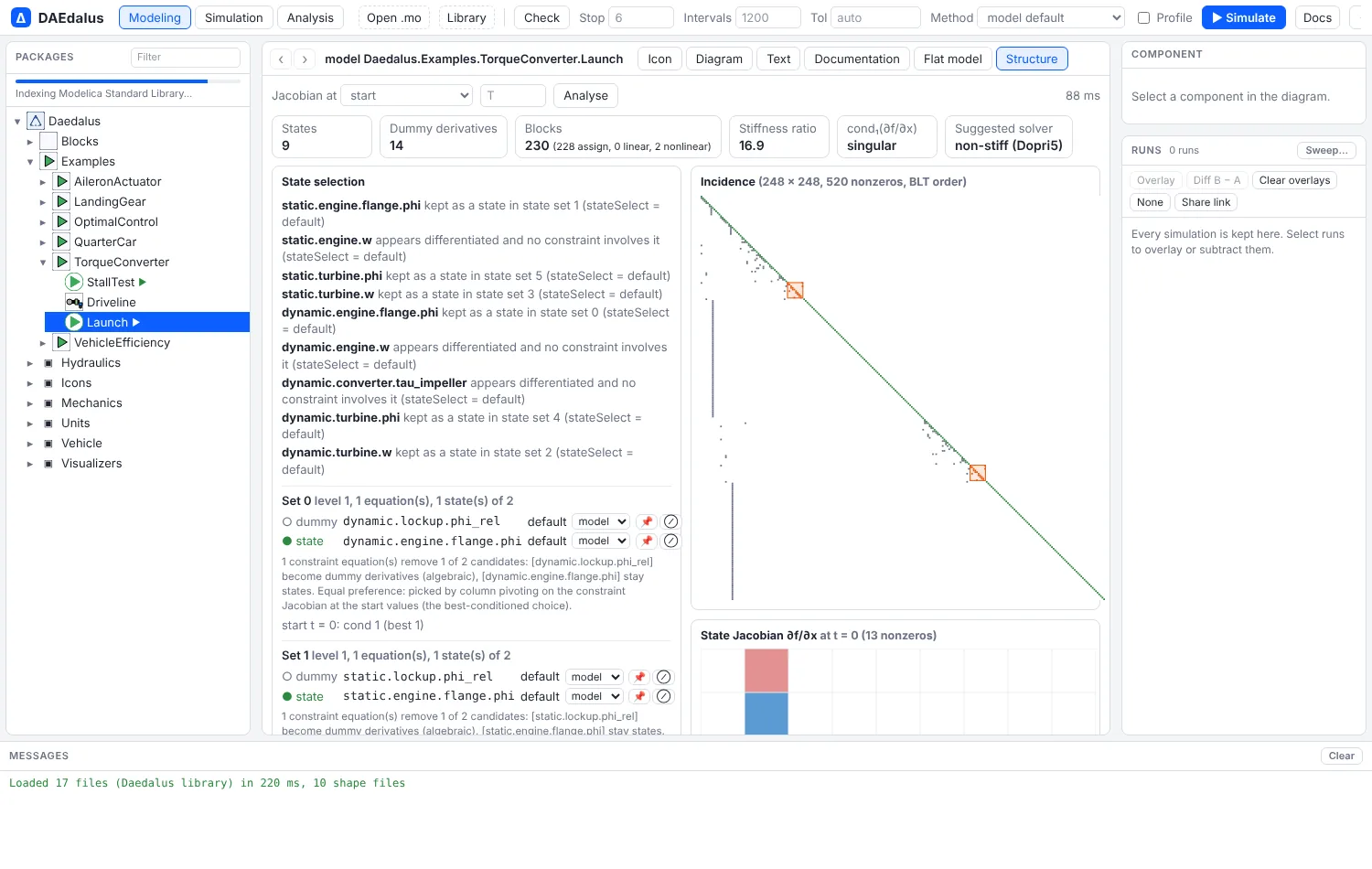
Open TorqueConverter.Launch and pick the Structure tab next to Flat model.
What it shows
- Variable roles: state, derivative, dummy derivative, algebraic, alias, parameter or discrete.
- BLT blocks in evaluation order: which equation computes which unknown and, for linear and nonlinear loops, the tear variables, the inner equations and the residuals. Click a block for its equations.
- The incidence matrix in BLT order, with the blocks outlined on the diagonal.
- State selection: for each candidate set of the dummy-derivative method, which
variables stayed states and which became dummy derivatives, their
stateSelecttiers, and the reason. - The state Jacobian
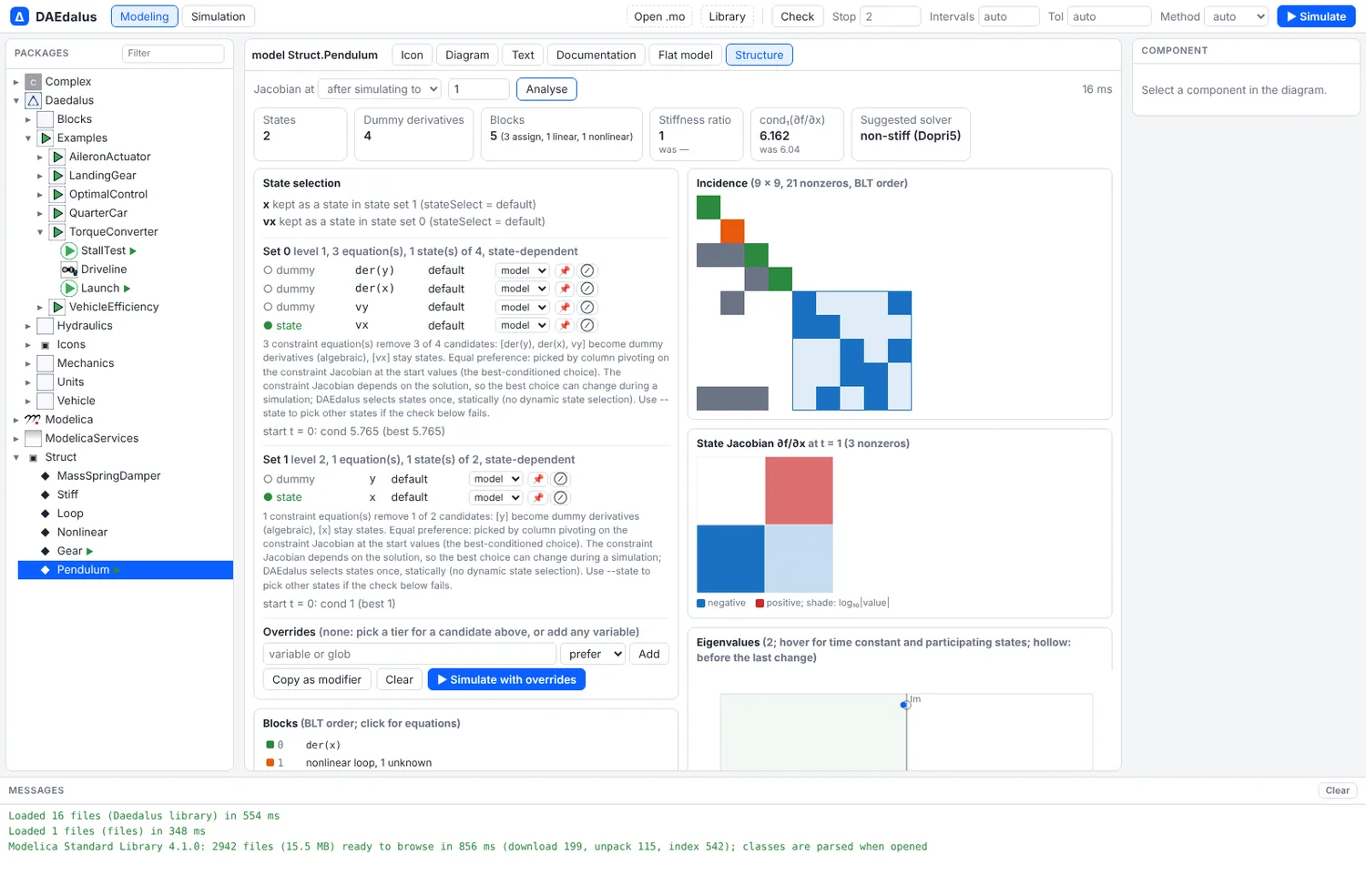
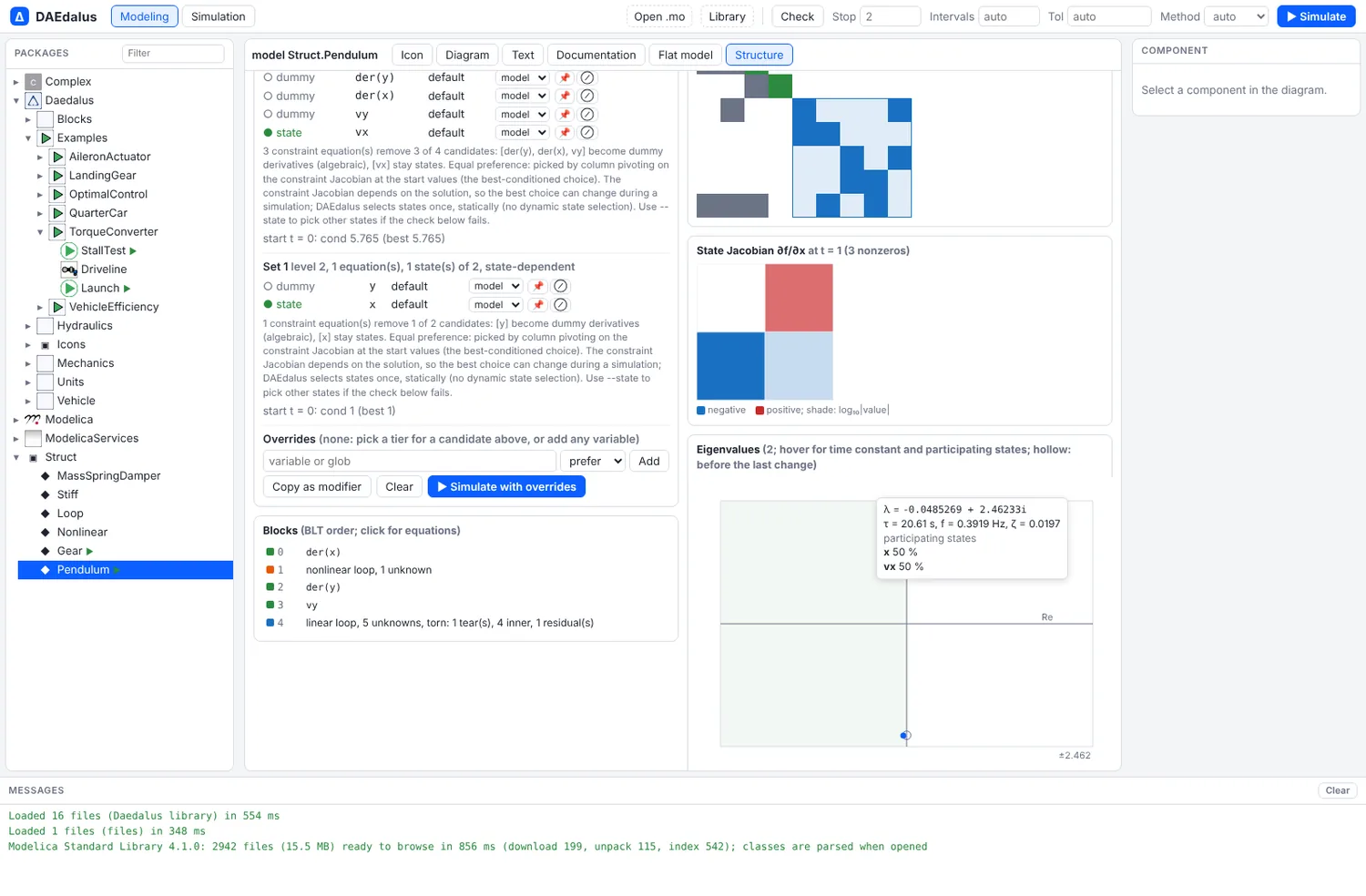
df/dxat the start or after simulating to a time: a heatmap of its entries, its sparsity and 1-norm condition number, and the eigenvalues in the complex plane. Hover an eigenvalue for its time constant, frequency, damping and the states that take part in it. - Stiffness: the ratio of the fastest to the slowest mode, with a stiff or non-stiff solver suggestion, and the condition number of each algebraic loop's Jacobian with respect to its tear variables.
Choosing states
DAEdalus selects states once, statically. When the best choice depends on the solution, as it does for the cartesian pendulum, a fixed choice can degenerate partway through a run. The structure report checks the choice along the simulated trajectory and warns when it fails, naming the states that would work there.
In the Structure view, each state candidate has a pin (always a state) and a forbid
(never a state) button. The model is translated again at once, and the new states,
eigenvalues and stiffness show next to the old ones before you simulate. Simulate with
overrides runs it, and Copy as modifier gives the equivalent modification for your
source, such as phi2(stateSelect = StateSelect.prefer). Overrides are kept per model
for the session.
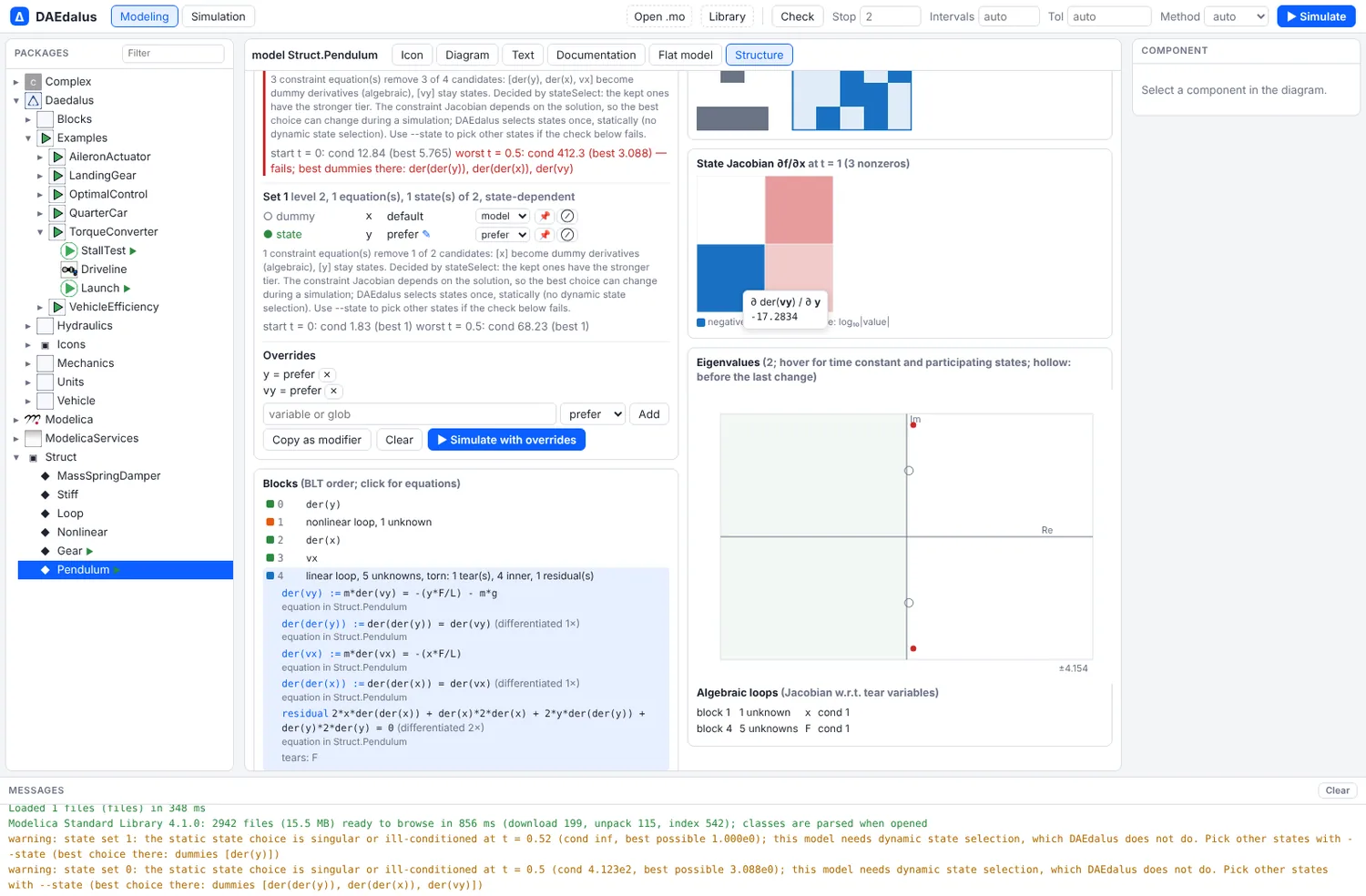
y and vy: the check along the run fails at the bottom of the swing, and the warning names the better choice.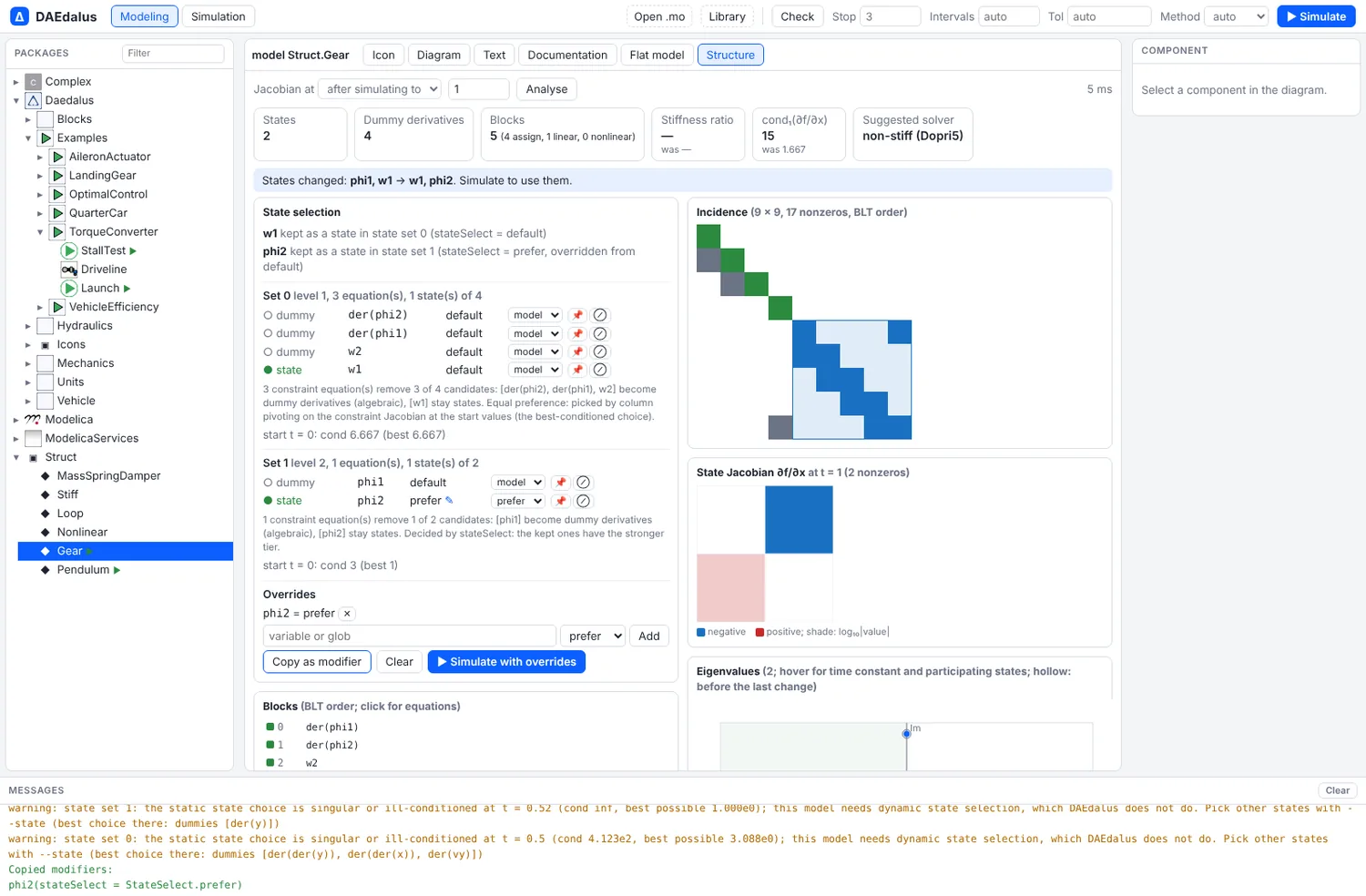
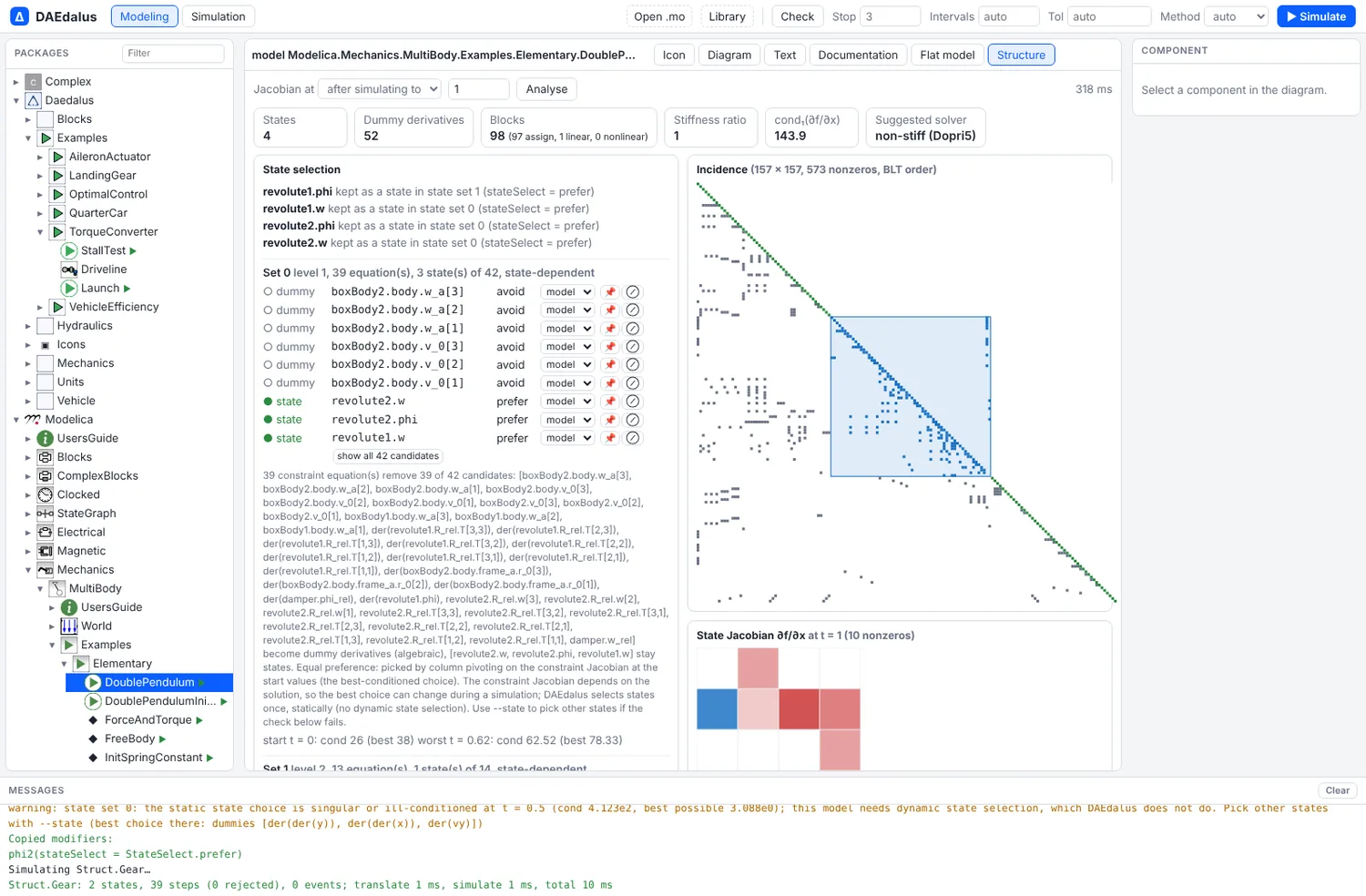
phi2 moves the state from one side of the gear to the other.The same works for MSL models, here Modelica.Mechanics.MultiBody.Examples.Elementary.DoublePendulum
with 42 candidates in its first state set:
On the command line
daedalus structure model.mo -m MyModel [--at T] [--format json] [--no-jacobian]

# choose other states, for any command; NAME may be a glob
daedalus simulate model.mo -m MyModel --state body.v=prefer --state 'arm.*.phi=avoid'
--state NAME=always|prefer|default|avoid|never sets the stateSelect of the matching
variables before alias elimination and index reduction. Later overrides win, and one that
matches nothing is reported. It works with check, dump, simulate, linearize,
structure, fmu and export-casadi.
For the cartesian pendulum of crates/daedalus-core/tests/models/structure.mo:
daedalus structure crates/daedalus-core/tests/models/structure.mo -m Struct.Pendulum --at 1structure of Struct.Pendulum
variables: 2 states, 4 dummy derivatives, 3 algebraic, 0 aliases, 3 parameters, 0 discrete
blocks: 5 (3 assignments, 1 linear loops, 1 nonlinear (torn 1))
incidence: 9 x 9, 21 nonzeros
states (2):
x: kept as a state in state set 1 (stateSelect = default)
vx: kept as a state in state set 0 (stateSelect = default)
blocks:
[0] der(x) := from der(x) = vx
[1] nonlinear loop, 1 unknowns: [y]
residual: x^2 + y^2 = L^2
[2] der(y) := from der(x)*2*x + der(y)*2*y = 0
[3] vy := from der(y) = vy
[4] linear loop, 5 unknowns, torn: 1 tears, 4 inner, 1 residuals: [der(vy), der(der(y)), der(vx), der(der(x)), F]
...
state Jacobian df/dx at t = 1:
2 x 2, 3 nonzeros (75.0 %), cond_1 = 6.162e0
stiffness ratio: 1.000e0
suggested solver: non-stiff (...; an explicit method (Dopri5) is efficient)
modes (eigenvalue, time constant, top states):
-4.852380e-2 - 2.462335e0i tau 2.061e1 s vx 50%, x 50%
-4.852380e-2 + 2.462335e0i tau 2.061e1 s vx 50%, x 50%Forcing y and vy as states with --state y=prefer --state vy=prefer --at 2 makes the
check fail where the pendulum passes the bottom:
    check at start: t = 0, cond = 1.284e1 (best choice 5.765e0)
    check worst: t = 1.52, cond = 4.617e2 (best choice 3.078e0) FAILS

warning: state set 0: the static state choice is singular or ill-conditioned at t = 1.52
(cond 4.617e2, best possible 3.078e0); this model needs dynamic state selection, which
DAEdalus does not do. Pick other states with --state (best choice there: dummies
[der(der(y)), der(der(x)), der(vy)])
The structure report is also a tool of the AI assistant
(model_structure), so it can explain why a model is stiff or which states it chose.